



December
1 December
 Quo Vadis? (Dir. Gabriellino D’Annunzio & Georg Jacoby, It, 1924) (Screening format – digital, 120 mins) Based upon the 1896 Nobel prize winning novel of the same name by Henryk Sienkiewicz, Quo Vadis? had already been filmed once in Italy with Enrico Guazzoni’s internationally successful epic version of 1913. The film tells of a love
 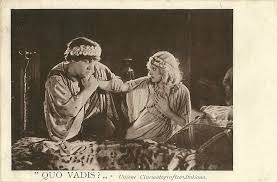 affair that develops between a young Christian woman and Marcus Vinicius, a Roman patrician. It takes place in the city of Rome under the rule of emperor Nero, c. AD 64. It was hoped that the 1924 remake would recapture the success of the historical epics of the previous decade. But it was
 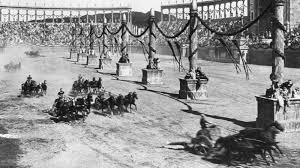 not to be. The film had a long gestation period and went wildly over budget. When additional financing had to be sought from Germany, Jacoby was brought in as co-
 director to oversee the work of D’Annunzio (son of the poet Gabriel D’Annunzio). Upon release, the film was a critical and commercial failure. D’Annunzion never made another film and Jacoby’s reputation also suffered. Only star Emil Jannings emerged with any merit, playing the crazed Nero. However, the film remains a spectacle on the grandest scale, one of the great epics of silent cinema, featuring a cast of thousands and a Nero played with satanic glee by Jannings. Find out more at ilcinemaritrovato.it. Introduced by Professor Maria Wyke. With live piano accompaniment. BFI Southbank, London Link
 Paul Merton’s Silent Clowns – Paul Merton makes a welcome return to The Cinema Museum introducing three films by his comedy heroes – Buster Keaton, Charlie Chaplin and Laurel and Hardy. In Seven Chances (1925), Buster Keaton plays a man who learns that he will inherit the family fortune – but only if he marries by 7pm that evening. The Pawnshop (1916) is one of Chaplin’s most popular shorts, famous for the sequence in which he destroys a client’s alarm clock. Laurel and Hardy are fugitives from prison in Liberty (1929). Their attempts to exchange trousers end up with them at the top of an unfinished skyscraper. With live piano accompaniment by Colin Sell. Cinema Museum, Lambeth Link
7 December
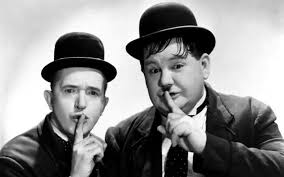 The Live Ghost Tent – The quarterly meeting of The Laurel and Hardy Society. Films being screened will include Battle of the Century (1927), one of cinema’s greatest custard pie fights. With recorded score. The Cinema Museum, London Link
8 December
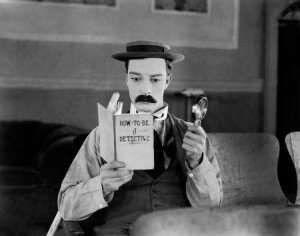 Sherlock Jr (Dir. Buster Keaton, 1924) (Screening format – not known, 45 mins) In Sherlock Jr, a kindly movie projectionist (Buster Keaton) longs to be a detective. When his fiancée (Kathryn McGuire) is robbed by a local thief (Ward Crane), the poor projectionist is framed for the crime. Using his amateur detective skills, the projectionist follows the thief to the train station – only to find himself locked in a train car. Disheartened, he returns to his movie theatre, where he falls asleep and dreams that he is the great Sherlock Holmes. Although not a popular
 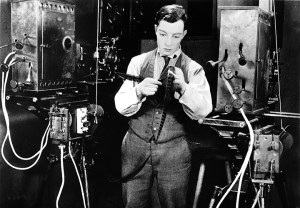 success on its initial release, the film has come to be recognised as a Keaton classic with its special effects and elaborate stunts making it a landmark in motion picture history. Find out more at silentfilm.org. Presented as part of the Highgate International Chamber Music Festival. With live musical accompaniment by a piano quintet score composed especially for the film, composer and Tchaikovsky Competition prize-winning pianist Stephen Prutsman. St Anne’s Church, Highgate. Link
11 December
 The Sideshow (Dir. Erle C. Kenton, US, 1928 ) ( Screening format – 35mm, 70mins ) Starring Marie Prevost, Ralph Graves, Alan Roscoe and ‘Little Billy’ Rhodes, this is an entertaining ‘programmer’ drama with a cast of colourful characters produced by “Poverty Row” Columbia Pictures, in which a circus is threatened by acts of sabotage organized by a rival company. Previously at Keystone, Kenton made
  seven films with star Marie Prevost, another alumna of Mack Sennett’s company. In the 1920’s, Canadian Prevost was Queen of the B’s, working for Universal and Warner Bros., acting in three films for Lubitsch, who thought extremely highly of her skills as an actress. Talented in both comedic and dramatic terms, this is a rare chance to see one of her films, unavailable on any other format than 35mm film! Find out more at silentfilm.org Presented by the Kennington Bioscope. With live musical accompaniment. Cinema Museum, Lambeth Link
13 December
 The Manxman (Dir. Alfred Hitchcock, UK, 1929) (Screening format – not known, 100mins) In a small fishing community (with beautiful Cornish locations standing in for the story’s Isle of Man setting), two boyhood friends are inseparable as youths but take different paths in adulthood. When they both fall in love with Kate, the daughter of a puritanical Methodist, they are forced to deal with their own moral codes and with the strict Manx society in which they live. The Manxman was Hitchcock‘s last silent film, and one of his very best. Adapted
  from a novel by Hall Caine, which had already spawned a successful stage play and a previous film adaptation (d. George Loane Tucker, 1916), it was Hitchcock‘s last collaboration with writer Eliot Stannard, whose credit appears on all but one of the silent films. The film was a commercial success, described in Bioscope as a film of “remarkable power and gripping interest”, yet neither Hitchcock nor producer John Maxwell were happy with the film. Although somewhat stagey in places, the film effectively demonstrates the extent to which Hitchcock‘s visual style had developed in a short period, with this tempestuous melodrama certainly bursting with bold, Hitchcockian bravado and it shines even brighter thanks to the complex, sensual performance of Anny Ondra, as Kate. Find out more at wikipedia.org With recorded orchestral score composed by Stephen Horne. BIMI, London Link
15 December
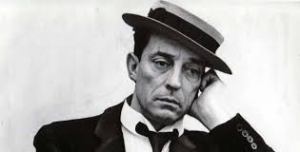 Buster Keaton’s Comedy Christmas Cracker. Three classic shorts from the master of stone-faced comedy. Featuring The Electric House (1922) in which Buster accidently agrees to re-wire a wealthy businessman’s mansion with the latest electrical mod cons; My Wife’s Relations (1922) which finds Buster the victim of mistaken identity, leading to his getting married, also by mistake; and, The Boat (1921), a tale of one family man’s determination to give his wife and children the life at sea they have always dreamed of (or he has at least). With live piano accompaniment by Lillian Henley. Palace Cinema, Broadstairs. Link
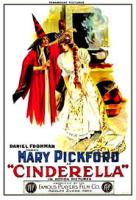 Cinderella (Dir. James Kirkwood, US, 1914) (Screening format – not known, 52 mins) The classic fairy tale of a poor urchin who finds her Prince Charming is brought to life by silent screen legend Mary Pickford, in one of the roles that made her “”America’s Sweetheart.””
  Employing ingenious uses of trick photography and stop-motion animation, Cinderella was a hit at the box office during Christmas week of 1914. The success of Pickford features such as Cinderella convinced Paramount mogul Adolph Zukor to give her complete artistic control over her films and a record-breaking $10,000 a week salary a mere two years later. Prince Charming is played by Pickford’s real-life husband, Owen Moore (he was not so charming in real life, as she would leave him for her second husband,
  Douglas Fairbanks, in 1920.) Director James Kirkwood began his career acting in D.W. Griffith pictures such as A Corner in Wheat (1909) and Home, Sweet Home (1914). A close friend of Pickford’s, he directed several of her films, including Home, Sweet Home (1914) and Fanchon the Cricket (1915). Despite his success behind the camera, he would continue acting well into the 1950s. The film was initially titled The Stepsister, presumably in an attempt to distinguish it from an earlier 1911 version starring Florence La Badie.Find out more at moviessilently.com With live organ accompaniment by Donald Mackenzie. Musical Museum, Brentford Link
31 December
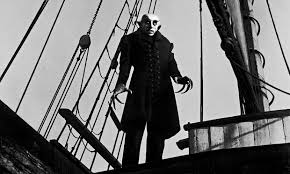 Nosferatu (Dir. F W Murnau, 1922) (Screening format – digital, 96mins) A German Expressionist horror masterpiece starring Max Shreck as the vampire Count Orlok. The film was an unauthorised adaption of Bram Stoker’s ‘Dracula’ with names and other details changed because the studio could not obtain the rights to the novel. Stoker’s heirs sued over the adaption and a court ruling ordered that all copies of the film be destroyed. However, a few prints survived and the film came to be regarded as an inspirational master work of the cinema. In the film, Count Orlok travels across Europe leaving a trail of death in his wake. Brilliantly eerie, with imaginative touches which later adaptions never achieved. Find out more at wikipedia.org With recorded James Bernard scored accompaniment. BFI Imax, London Link
 Silentfilmcalendar.org