



5 July
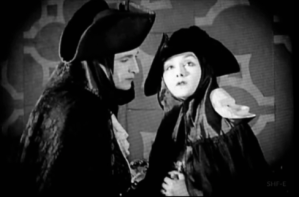 Man Without Desire (Dir Adrian Brunel, 1923) (Screening format – 35mm) 18th-century Venetian Count Vittorio Dandolo (Ivor Novello) is devastated by the death of his lover Leonora (Nina Vanna) and loses all interest in life. Wishing to escape from his grief, he devises a method of putting himself in a state ofsuspended animation. He awakens 200 years later in 1920s Venice where he meets Genevia, Leonora’s double, who turns out to be a descendant of
 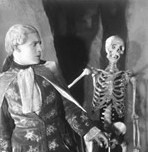 his former love. Falling immediately in love with Genevia, he proposes marriage which Genevia accepts. He then discovers that his 200-year slumber has left him with the ability to love but unable to experience passion, and the marriage remains unconsummated. The film was Brunel’s feature-length directorial debut and has been described as “one of the stranger films to emerge from Britain in the 1920s”. The film’s theme of loss of sexual desire, and by implication impotence, was exceptionally frank for its time; oddly however, it appears to have been passed for release without interference by the British film censors, who at this period has a reputation for extreme zealousness where sexual matters in film were concerned. Find out more at imdb.com With live piano accompaniment by Costas Fotopoulos. BIMI, Birkbeck College, London Link
7 July
 Light of Asia (Dir. Franz Osten, Ger/Ind, 1925) (Screening format – 35mm, 98mins) This adaptation of Edwin Arnold’s 1861 eponymous epic poem tells the story of Prince Siddhartha Gautama, the man who became the Buddha. It was the project of screenwriter Niranjan Pal and producer and lead actor Himansu Rai, who were passionate about promoting Indian culture in film. When they found no English backers, they made a co-production deal with Emelka Films in Munich and succeeded in making the first Indian film to be distributed internationally. Shot entirely on location in India and with no artificial lighting, it’s a simple story made with respect for its religious subject, and is both beautiful and moving.. Find out more at academia.edu Introduced by Cary Rajinder Sawhney, Director of London Indian Film Festival. With live musical accompaniment. BFI Southbank, London Link
8 July
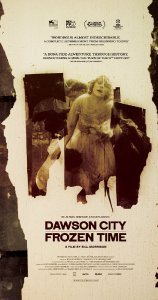 Dawson City – Frozen Time (Dir. Bill Morrison, US, 2016) This documentary pieces together the bizarre true story of a collection of some 500 films dating from 1910s – 1920s, which were lost for over 50 years until discovered buried in a sub-arctic swimming pool deep in the Yukon Territory, in Dawson City, located about 350 miles south of the Arctic Circle. Using these permafrost protected, rare silent
  films and newsreels, archival footage, interviews and historical photographs to tell the story, and accompanied by an enigmatic score by Sigur Rós collaborator and composer Alex Somers (Captain Fantastic), Dawson City: Frozen Time depicts a unique history of a Canadian gold rush town by chronicling the life cycle of a singular film collection through its exile, burial, rediscovery, and salvation – and through that collection, how a First Nation hunting camp was transformed and displaced. Find out more at picturepalacepictures.com . Prince Charles Cinema, London Link
24 July
 A Cottage on Dartmoor (Dir. Anthony Asquith, 1929) (Screening format – not known, 84mins) Joe (Uno Henning) works as a barber in a shop in a Devon town, alongside a manicurist called Sally (Norah Baring). He becomes infatuated with her and asks her out but it is clear that Sally does not
  reciprocate Joe’s feelings. Joe’s infatuation with her develops into obsession. Meanwhile a young farmer Harry (Hans Schlettow), begins to woo Sally and the couple begin seeing each other which leaves Joe in despair. After a fight with Harry, Joe is jailed but swears revenge on Harry and Sally. A Cottage on Dartmoor is a tale of love and revenge set in the bleak landscape of Dartmoor and a thoughtful distillation of the best of European silent film techniques from a director steeped in the work of the Soviet avant-garde and German expressionism. One of the last films of the silent era and a virtuoso piece of film-making, A Cottage on Dartmoor was a final passionate cry in defence of an art form soon to be obsolete. Find out more at silentfilm.org. Presented by The Lucky Dog Picturehouse. With live musical accompaniment . Wilton’s Music Hall, London Link
25 July
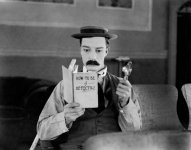 Sherlock Jnr (Dir. Buster Keaton, 1924) (Screening format – not known, 45 mins) In Sherlock Jr, a kindly movie projectionist (Buster Keaton) longs to be a detective. When his fiancée (Kathryn McGuire) is robbed by a local thief (Ward Crane), the poor projectionist is framed for the crime. Using his amateur detective skills, the projectionist follows the thief to the train station – only to find himself locked in a train car. Disheartened, he returns to his movie theatre, where he falls asleep and dreams that he is the great Sherlock Holmes. Although not a popular success on its initial release, the film has come to be recognised as a Keaton classic with its special effects and elaborate stunts making it a landmark in motion picture history. Find out more at silentfilm.org. Presented by The Lucky Dog Picturehouse. With live musical accompaniment . Wilton’s Music Hall, London Link
26 July
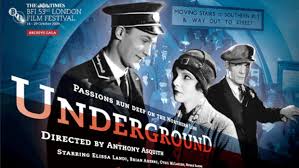 Underground (Dir. Anthony Asquith, GB, 1928) (Screening format – not known, 84 mins) In 1920s London, during a normal hectic day on the Underground, mild mannered Northern Line porter Bill (Brian Aherne) falls for shop worker Nell (Elissa Landi). But their relationship is threatened by power station worker Burt (Cyril
 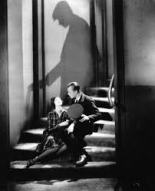 McLaglan) who also has eyes for Nell. Consumed by jealousy, Burt plots to discredit Bill with a plan that results in a daring chase through London’s underground and across rooftops of the city. Although Underground was only Asquith‘s second film he handles the melodramatic story with confidence and great sophistication. Underground is a rare study of 1920s working-class London, and offers a fascinating and historically interesting glimpse of its public transport system. Find out more at screenonline.org.uk. Presented by The Lucky Dog Picturehouse. With live musical accompaniment by Tom Marlow . Wilton’s Music Hall, London Link
27 July
 The Dragon Painter (Dir. William Worthington, USA, 1919) (Screening format – digital, 61 mins) Remembered now mostly for his magnificent performance as the Japanese officer in The Bridge over the River Kwai, Sessue Hayakawa was one of the great stars of the silent cinema. In many films he played a dashing, romantic lead — a rarity for Asian actors in Hollywood, even today.
 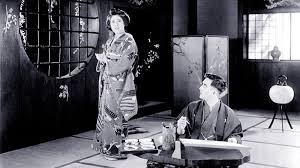 Hayakawa became so popular and powerful that he was able to start Haworth Pictures to control his own destiny. The Dragon Painter was the finest of the Haworth productions. Beautifully acted, gorgeously shot (with Yosemite Valley filling in for the Japanese landscape), and lovingly directed, the film is an absolute marvel. Hayakawa plays Tatsu, an artist living as a hermit in the wilds of Japan. Thought mad by the local villagers, he believes that his princess fiancée has been captured by a dragon. His obsession leads to artistic inspiration. It isn’t until a surveyor comes across Tatsu in the mountains that his genius is discovered. The surveyor informs the famed artist Kano Indara about his discovery. Kano is desperate to find a male heir to teach his art, but when Tatsu meets Kano’s daughter (played by Hayakawa’s wife, Tsuru Aoki) and sees
  only his lost princess, a clash of wills brings the household to the brink of disaster. Long considered lost, The Dragon Painter was rediscovered in a French distribution print and brought to the George Eastman House for restoration with the original tints. The film survives today as a tribute to Hayakawa’s great artistry and a shining example of Asian-American cinema. Find out more at silentfilm.org. Screened as part of the Cinema Rediscovered Festival. With an introduction by author, critic and film historian Pamela Hutchinson. With (recorded?) score by Japanese-American composer Mark Izu. Watershed, Bristol Link
 Nosferatu: A Symphony of Horror (Dir. F W Murnau, 1922) (Screening format – not known, 96mins) In this first-ever screen adaptation of Bram Stoker’s novel Dracula, a simple real-estate transaction leads an intrepid businessman deep into the superstitious heart of Transylvania. There he encounters the otherworldly Count Orlok (portrayed by the legendary Max Schreck, in a performance the very backstory of which has spawned its own mythology) who soon after embarks upon a cross-continental voyage to take up residence in a distant new land… and establish his ambiguous dominion. The film was an unauthorised adaption of Stoker’s ‘novel with
  names and other details changed because the studio could not obtain the rights to the story. Stoker’s heirs sued over the adaption and a court ruling ordered that all copies of the film be destroyed. However, a few prints survived and the film came to be regarded as an inspirational master work of the cinema. Brilliantly eerie, with imaginative touches which later adaptions never achieved and featuring some of the most iconic images in cinema history, Nosferatu continues to haunt modern audiences with its unshakable power of gothic imagery and blood curdling suspense.. Find out more at www.rogerebert.com With live organ accompaniment by Donald Mackenzie. Musical Museum, Brentford Link
29 July
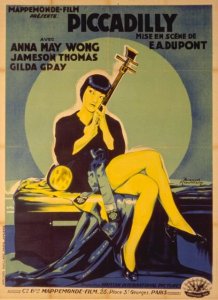 Piccadilly (Dir E A Dupont, UK, 1929) (Screening format – not known, 92 mins) A film noir before the term was in use, uncredited German director E.A. Dupont’s Piccadilly is one of the true greats of British silent films, on a par with the best of Anthony Asquith or Alfred Hitchcock during this period. Valentine Wilmot (Jameson Thomas) owns a nightclub featuring dancers Mabel (Gilda Gray) and Vic (Cyril Ritchard). After a confrontation with Wilmot, Vic quits
  performing at the club. When the joint starts losing business, a desperate Wilmot hires former dishwasher Shosho (Anna May Wong) as a dancer. She is an instant hit and forms a rapport with Wilmot, which makes both Mabel and Shosho’s friend (King Ho Chang) jealous, leading to a mysterious murder. A stylish evocation of Jazz Age London, with dazzlingly fluid cinematography and scenes ranging from the opulent West End to the seediness of Limehouse. One of the pinnacles of British silent cinema, Piccadilly is a sumptuous show business melodrama seething with sexual and racial tension – with an original screenplay by Arnold Bennett. Find out more at screenonline.org.uk . Presented by The Lucky Dog Picturehouse. With live musical accompaniment by Christopher Eldred . Wilton’s Music Hall, London Link
 Silentfilmcalendar.org