
BFI Southbank
17 November 2024
(Contains Spoilers Throughout)
As part of its Art of Action season, BFI Southbank has a film strand entitled Woman Kings, highlighting women stars of action films from the 1970s to the present day. But, as any fan of silent film will tell you, female action stars of the cinema didn’t originate with Pam Grier or Cynthia Rothrock or Michelle Yeoh or Linda Hamilton. No, female action stars have been around since the earliest days of the flickering screen. So it was a timely choice by Bryony Dixon, BFI Curator of Silent Film, to put together a short compendium of silent films highlighting some of the now largely forgotten action women of silent film for the latest monthly silent slot at BFI.
Because when it comes to female action stars in silent film there are certainly some major myths to dispel. In particular, the idea that all female stars were simpering damsels in distress, hair invariably 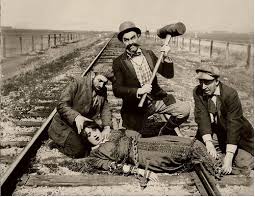 in ringlets, crinolines a billowing, probably tied to a railway track and just waiting for the silent hunk to come and save them. OK, so Mabel Normand found herself in just this situation in Barney Oldfield’s Race For Life (1913) but this was more a parody from the Mack Sennett stable so can’t really be seen to be making a point. In fact, by the 1910s it was just as likely
  that the heroine would be rescuing the man and saving the day because by this time two of cinema’s biggest names were female action stars Pearl White and Helen Holmes, with White starring in
 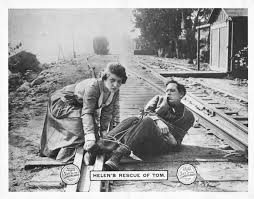 The Perils of Pauline serial (1914) and Holmes in serials The Hazards of Helen (1914-15) and Lass of the Lumberlands (1916). And these were no shrinking violet film stars either, with both White and Holmes performing most of their own stunts, leaping on and off trains, jumping from train to train or flying in balloons and aeroplanes.
 But female action stars weren’t just an American phenomenon, they were
  just as likely to crop up in European films, some even pre-dating their serial queen counterparts in the US. Once seen, never forgotten was Christina Ruspoli as the arch criminal in Filibus (1915) while Pola Negri led her robber band in The Wildcat (1921) and Asta Nielsen donned male disguise and a sword to play a cross dressing Hamlet (1921).
But before all that, there was our first film of the afternoon, A Wife’s Revenge (or The Gamblers End). Made in Britain in November 1904 this was a blink-and-you’ll-miss-it four minute long, two-scene gem. In scene one, four men are playing cards for money and one is losing heavily. His wife looks in to see how he is doing. When she departs the game resumes and he loses again but then discovers one of the other players to be cheating and challenges him to a duel with swords. In scene two, the four gamblers have moved outdoors. The two swordsmen begin to fight and, just as his wife arrives, the husband is mortally wounded. The wife runs to comfort her husband but seeing that it is too late she picks up his sword to continue the duel, eventually killing the other swordsman. The End!!
The film is so much fun because it is so surprising. Who would have expected the elegantly dressed Edwardian lady with smart bonnet and long skirt to be so adept with a sword, confidently running through her adversary and avenging her husband. But who was she? We’re unlikely ever to know  because the film dates from a time when not even the director let alone the stars got a credit. All that is known is that the film was made by the Cricks and Sharp studio. Run by George Howard Cricks (who had previously worked for R W Paul) and Henry Martin Sharp (nfi), the studio was based in Mitcham, South London with the partnership lasting from 1904 until 1908 when Sharp was replaced by John Howard Martin (another former Robert Paul employee). Making upwards of a film a week, their products were marketed under the ‘Lion’s Head’ brand.
 Next up was an episode of the British Topical Budget newsreel (No. 545-2 from 1922) with an all too brief glimpse of US action woman Babe Kalishek, an early
  exponent of the somewhat hazardous ‘sport’ of aeroplane wing-walking. Kalishek’s own life story cries out for a film biography in itself. Leaving home as a teenager, she worked in a traveling vaudeville act as a singer and an animal trainer before training animals in California for silent films. Seeing an advert for Barr’s Flying Circus, “Wanted – Experienced Ariel Stunt Woman”
  and despite having no aviation experience whatsoever, she got the job. Within weeks she was Barr’s star performer. She was not yet quite 16 years old. Performing to crowds of up to 100,000, as well as wing-walking she would jump from plane to plane, hang by her knees or her teeth and was the first woman to make a parachute jump. At air-shows she even got top billing above Amelia Earhart. Kalishek gave up her wing walking career in 1925 when, having previously learned to fly herself, she returned home to open her own flying school.
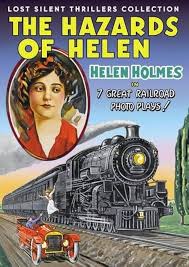 It was then back to the fictional action heroine but one played by a real life action woman, Helen Holmes, who starred in the first 48 episodes of the hugely popular and long running serial The Hazards of Helen. In episode three, The Girl At The Throttle, we get to see Helen as a railway telegraph operator. When the fireman of a locomotive is called away to tend to his sick wife, the engineer is left in sole charge. But when he is accidentally shot by a hunter, the
  locomotive becomes a runaway, en route to collide with the Eastbound Express. Recognising the danger, Helen jumps into a stationary locomotive and speeds off after the Express, catching them just in time to avoid a collision.
Given some of Helen’s exploits in later episodes, The Girl At The Throttle is perhaps a little disappointing (and conveniently ignores the fact that with no one to stoke the locomotive’s fire it will quickly run out of steam and come to a halt!!). Sure, she jumps into a standing locomotive and speeds off to the rescue but in later episodes Helen is filmed jumping off bridges or water towers  onto moving trains, jumping off moving trains onto a car or a horse, riding motorbikes and fighting off crooks. And in most of these scenes, Holmes did her own stunt work. But who came up with the ideas for the stunts? The daughter of a railroad engineer, there is more than a
  suggestion in contemporary publicity materials that it was Holmes herself who formulated scenarios for many of the stunts.
The Hazards of Helen made Holmes a major star and was a big money spinner for the production company Kalem Films. But in 1915 Helen and her then husband J P MacGowan (who directed most of her episodes) decided to leave Kalem, initially joining Thomas Ince Productions and then establishing their own independent company, Signal Productions, making their own action films. Despite reasonable success, financial and distribution problems resulted in Signal’s demise in 1917. Holmes made the occasional films for other companies but by 1926 her popularity had waned and she retired from the screen, married a Hollywood stuntman and saw out her days running an antiques business.
 The next film saw us switch from America to Europe and the exploits of Danish action woman Emile Sannom. Sadly, very few of Sannom’s films have survived but what we did get to see was a 1923 compilation of some of her most impressive stunt work. Called Daredevil of the Movies, the film was supposedly used by Sannom to illustrate her work when speaking to audiences across Denmark. Amongst the many stunts highlighted, we see Sannom swimming out to and then entering a submarine, escaping from a burning windmill by
 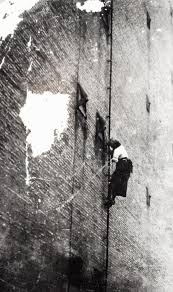 climbing down its moving sails, climbing down assorted multi-storey buildings and chimney stacks, hanging from the wheels of an aircraft and, perhaps most impressively, parachuting from an aircraft onto the spire of a church which she then climbs down. Sadly there is quite a bit of nitrate damage on the film but this does little to detract from Sannom’s breathtaking stunts, all undertaken with what looked to be the scantest attention to ‘health and safety’. No safety wires here or nets to catch her if she falls, one slip meant death.
Sannom was born in 1886 and first appeared in films around 1909 but it was two films appearing opposite the great Asta Nielsen that sealed her reputation first as an actress and then as a stunt woman. In The Abyss (1910) she plays Nielsen’s love rival with the two women eventually fighting it out over a mutual love  interest. Hamlet ( 1911) provided Sannom with a more substantial role, playing Ophelia, But it was Ophelia’s death scene, throwing herself into the castle moat to drown, that foretold Sannom’s future, becoming Denmark’s first film actress to perform as a stunt woman. A year later she found fame as a star of the genre known as sensationsfilm, films featuring spectacular action scenes and stunts, with her production company heralding her as “The Number One Daredevil of Denmark.” In all, she made some 85 films including two highly popular film series
  about bold female detectives with Sannom playing the main character. But following two films made in Germany and another in Italy Sannom gave up film work in 1922 to concentrate on the stage. However, she also continued her stunt work, frequently performing public parachute jumps from aeroplanes, sometimes only wearing a bathing suit and high-heeled shoes. And it was here in 1931 that tragedy struck when her parachute failed to open and she plunged to her death in front of some 8,000 spectators. She was just 44 years old.
Sannom’s compilation film, ‘Daredevil of the Movies’, can be viewed here
 The final film of the afternoon took us to Italy and Victory or Death (1913) starring Berta Nelson. She plays Blanche, the daughter of General Alberti who has just taken charge of some secret military papers. Blance looks initially to be a demure and love-lorn female who has fallen for the charms of Count Moro. But when the Count (in reality the secret agent Bernard, working for a foreign power) chloroforms her and steals her father’s secret papers a new side to Blanche emerges. Determined to get the papers back and save her father’s honour she discovers that Bernard has departed by passenger ship. Not to be
  outdone she hires an aircraft and sets off after him. On reaching the ship she jumps from the aircraft into the water and is rescued by the crew. But as she tries to steal back the papers Bernard catches her and ties her up as a fire breaks out on the ship.
Just as the ship sinks Blanche escapes into the water and is rescued by Wilkinson, a wealthy man cruising in his yacht. Blanche and Wilkinson set off together to recover the papers. Passing themselves off as man and wife they discover Bernard and befriend him. Feigning feelings for Bernard, Blanche agrees to meet him at his apartment. With Wilkinson waiting outside Blanche drugs Bernard’s champagne. Blanche and Wilkinson recover the papers but Bernard’s servant has called the 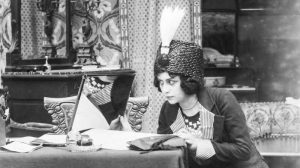 police and the chase is on. Escaping first by car and then aeroplane, Blanche returns the papers to her father and saves his honour while her friendship with Wilkinson has turned into love.
Victory or Death is just great fun to watch, very much setting the style for subsequent European films such as Mario Roncoroni’s Filibus (1915) or Louis Feuillade’s Les Vampires (1915). And Berta Nelson as Blanche seems to be having just as much fun as the audience, clearly whooping it up as she takes to the air in a plane although the dive from aeroplane 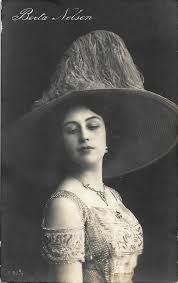 into the ocean is implied rather than shown and in one or two scenes she benefits from a stunt double. And her look of triumph as she reveals to the drugged and helpless Bernard her true identity is just a joy to watch. Very little is known of Berta Nelson’s life other than that she was born in Odessa, probably in 1890 and that she first achieved international fame as an opera singer. Arriving in Italy in 1912 she made the first of 18 film appearances that year, eventually starting her own production company, Nelson Film, which made four films in which she starred, the last of which was released in 1923, after which she is lost to history.
Directed by Segundo de Chomón, Victory or Death would appear to 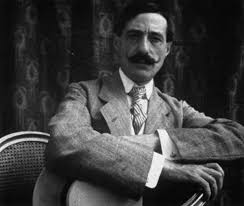 be a little out of character for a director better known for films with more of a fantasy theme and featuring camera tricks, optical illusions and animation. So it is perhaps not surprising that the stand-out scenes in the film were those of the liner on fire and sinking. While the model work was good the scenes of panic among the passengers and crew as they sought to abandon ship was genuinely thrilling,
  with jets of flame shooting up and floods of water cascading down stairways. But that is not to say his handling of the rest of the film wasn’t in any way below par.
  This would be one of the last films directed by Chomon, after which he worked primarily on creating visual effects for the films of others, including Guido Brignone’s Maciste in Hell (1925) and Abel Gance’s Napoleon (1927). And while the acting style of Victory or Death may have been of its era with a considerable degree of over theatricality while the plot relied heavily on some absurd coincidences (as do so many other silent films) but the film certainly flowed at a cracking pace and the action scenes were well executed (except possibly the final car chase which seemed to take place at about 5mph!!).
Victory or Death is definitely an early silent worth catching up with and if you want to see for yourself, you can watch it here courtesy of Amsterdam’s Eye Filmmuseum.
So, if you think that your Ellen Ripleys, your Sarah Connors or your Imperator Furiosas are the be-all and end-all of female action film stars then think again, because the likes of Helen Holmes, Emile Sannom and Berta Nelson were setting the template for the female action star a hundred years earlier.
Providing live musical accompaniment for all of the films was pianist John Sweeney who had his work cut out in keeping up with the pace of the action but whose playing added immeasurably to the thrills and drama on screen.
 Silentfilmcalendar.org